Which of the 7 Money Personalities Are You and What Are Its Pitfalls?
Our relationship with money is shaped by beliefs, emotions, life experiences, and the examples we have seen from family, friends, and society. Those influences can affect how we save, spend, invest, respond to market volatility, and make decisions about retirement.
This article uses the seven money personality types described by Ken Honda in his discussion of the psychology of money and happiness. It is intended as a self-reflection tool—not a diagnosis. Most people see themselves in more than one type, and our tendencies can change as life circumstances change.
Understanding your tendencies can help you recognize financial strengths, identify blind spots, and make decisions that better support the life you want. In financial planning, the goal is not to eliminate emotion from money decisions; it is to build practical systems that keep emotions from unintentionally derailing your priorities.
A quick self-check
As you read, consider which statements feel familiar:
- Do you find it hard to spend—even when doing so would support goals you value?
- Do you seek the excitement of a big investment win or a speculative opportunity?
- Do you postpone financial tasks because they feel stressful, tedious, or overwhelming?
- Do you alternate between strict saving and unplanned spending?
- Does uncertainty about the future keep you from feeling secure, regardless of your financial position?
The answers can be useful starting points for a conversation about cash flow, investment risk, retirement income, taxes, and estate goals.
Let's delve into each personality type's characteristics and your potential pitfalls and explore how professional financial guidance can help address your specific challenges. We'll explore each personality and how they influence financial decision-making, from budgeting to long-term investment strategies.
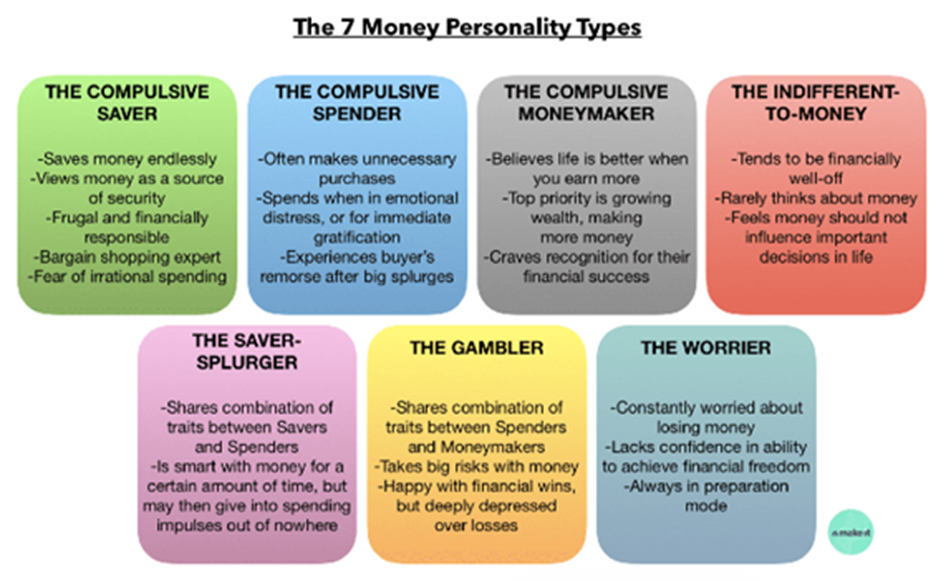
1. The Compulsive Saver
Signs you might be a Compulsive Saver
- You feel a strong need to save continually, sometimes without a specific goal for the money.
- Saving helps you feel secure.
- You are highly frugal and may focus intensely on finding the lowest price.
Potential pitfalls
- Fear of running out of money may make it difficult to use resources for experiences, family, charitable goals, or other priorities.
- You may save diligently but hesitate to develop a plan for retirement spending, gifting, or legacy goals.
A planning-focused next step
A written financial plan can help distinguish between money needed for long-term security and money available for meaningful spending. Retirement-income projections, cash-reserve targets, and estate-planning goals can provide a framework for deciding when spending is reasonable rather than simply risky. Learn more about comprehensive financial planning and retirement planning strategies.
2. The Compulsive Spender
Signs you might be a Compulsive Spender
- You spend money on things you do not necessarily need.
- You enjoy treating other people or making purchases that create an immediate lift.
- When you are under emotional stress, spending can feel like a quick source of relief or gratification.
Potential pitfalls
- Unplanned purchases can erode cash flow, increase debt, and make it harder to fund retirement savings or other goals.
- Repeated spending beyond income can create a stressful cycle of debt and additional spending.
A planning-focused next step
Start with a clear view of income, recurring expenses, debt payments, and savings goals. Automating retirement contributions, debt payments, and transfers to a dedicated emergency reserve can reduce the number of in-the-moment decisions. A waiting period for larger nonessential purchases can also create useful space between an urge and a decision. See our practical guidance on cash reserves and managing expenses.
If spending feels difficult to control, is hidden from loved ones, or is causing significant distress, a qualified mental-health professional can be an important complement to financial planning.
3. The Compulsive Moneymaker
Signs you might be a Compulsive Moneymaker
- You believe that earning more money is central to happiness or security.
- You devote substantial energy to building income, wealth, or multiple income streams.
- Recognition for financial success feels especially meaningful.
Potential pitfalls
- Work and wealth accumulation can begin to crowd out relationships, health, rest, and other sources of fulfillment.
- It can be difficult to define what “enough” means, even when your financial position is strong.
A planning-focused next step
Define the purpose of your wealth alongside the amount you want to accumulate. A financial plan can connect savings and investment decisions with lifestyle priorities, charitable giving, family goals, business planning, and retirement timing. Clarifying your target lifestyle and resources can help you make intentional tradeoffs rather than continually postponing what matters most.
4. The Indifferent-to-Money
Signs you might be an Indifferent-to-Money type
- You rarely think about financial matters, and budgeting or account organization feels unpleasant.
- You may believe money should not drive important life decisions.
- You value experiences, relationships, or purpose more than accumulating wealth.
Potential pitfalls
- Avoiding financial details can lead to missed savings opportunities, overlooked debt, insufficient insurance, or a retirement shortfall discovered too late.
- Delegating all financial responsibility to a spouse, partner, or another person can leave you unprepared if circumstances change.
A planning-focused next step
You do not need to make finances a daily focus. Instead, create a simple system: automate savings and bill payments, maintain a basic list of accounts and obligations, and schedule periodic check-ins. A one-page financial snapshot can make it easier to stay informed without allowing financial tasks to consume your time. Comprehensive financial planning can organize cash flow, investments, insurance, retirement, and estate considerations into a coordinated view.
5. The Saver-Splurger
Signs you might be a Saver-Splurger
- You identify with both Saver and Spender tendencies.
- You may save consistently for a period and then make an impulsive purchase.
- When you spend from savings, it may be on items you later use infrequently or regret buying.
Potential pitfalls
- Moving between strict saving and unplanned splurging can feel emotionally exhausting.
- You may lose confidence in your ability to follow through on financial goals.
A planning-focused next step
Give both saving and spending a place in your plan. Consider separate accounts or “sinking funds” for travel, home projects, gifts, and other known expenses. Before a larger purchase, compare it with the goals it could delay and use a 48-hour or one-week waiting period. This creates room for enjoyable spending while protecting core retirement, debt-repayment, and emergency-reserve priorities.
6. The Gambler
Signs you might be a Gambler
- You share traits with Moneymakers and Spenders.
- The thrill of risk and the possibility of a large reward can be especially appealing.
- You may take financial risks, trade frequently, or gamble to relieve boredom or seek excitement.
Potential pitfalls
- Concentrated investments, frequent trading, leverage, or gambling losses can impair long-term goals.
- A desire to recover losses can lead to decisions that exceed your risk tolerance or draw on funds intended for retirement, education, or essential needs.
A planning-focused next step
Separate essential goals from speculative decisions. An investment policy and target asset allocation can help align portfolio risk with your time horizon, liquidity needs, and ability to withstand losses. If you choose to allocate money to higher-risk ideas, establish a clearly defined amount that you can afford to lose without jeopardizing your core plan. Learn more about investment portfolio management during volatile markets. To discuss whether your portfolio’s asset allocation and risk level remain appropriate, schedule a free consultation.
If gambling is becoming difficult to manage or is affecting your finances or relationships, seeking specialized support is an important step.
7. The Worrier
Signs you might be a Worrier
- You worry frequently about losing money or running out of money, regardless of your current financial position.
- You may focus on worst-case scenarios and feel uncertain about your ability to reach financial independence.
- Market headlines, account balances, or upcoming expenses can create ongoing stress.
Potential pitfalls
- Financial anxiety can make it harder to make timely decisions or can lead to avoiding statements, planning tasks, and conversations.
- Excessive caution may lead to holding more cash than needed for long-term goals or abandoning a suitable investment strategy during volatile periods.
A planning-focused next step
Replace vague uncertainty with a written plan and a regular review process. Stress-testing a retirement plan, establishing an emergency reserve, reviewing insurance needs, and setting an appropriate investment allocation can help turn “what if?” questions into specific decisions. Our article on resilient retirement planning strategies discusses ways to evaluate uncertainty in a retirement plan.
Financial planning can help organize the decisions within your control. When worry feels persistent or overwhelming, discussing it with an appropriate qualified health professional may also be helpful.
Turn insight into a plan
Recognizing a money personality is not about judging yourself or fitting into a single label. It is about noticing patterns that may influence decisions about spending, saving, investment risk, retirement, taxes, insurance, and the legacy you want to leave.
At Financial Life Planning, LLC, we work with individuals, families, and small business owners to develop financial and retirement strategies that reflect their goals, resources, values, and comfort with risk. As an Independent Client Fiduciary and Registered Investment Adviser based in Marlton, New Jersey, we provide comprehensive financial planning, investment advisory, and wealth-management services.
Ready to discuss the money habits and decisions shaping your financial life? Schedule a free consultation to explore how a coordinated plan may help you move forward with greater clarity and confidence.
Edward C. Goldstein, CFP®, MBA, President
CERTIFIED FINANCIAL PLANNER ™ Practitioner
Financial Life Planning, LLC
10,000 Lincoln Dr. East, Suite 201
Marlton, NJ 08053
Phone: 856-988-5480
Fax: 908-292-1040